
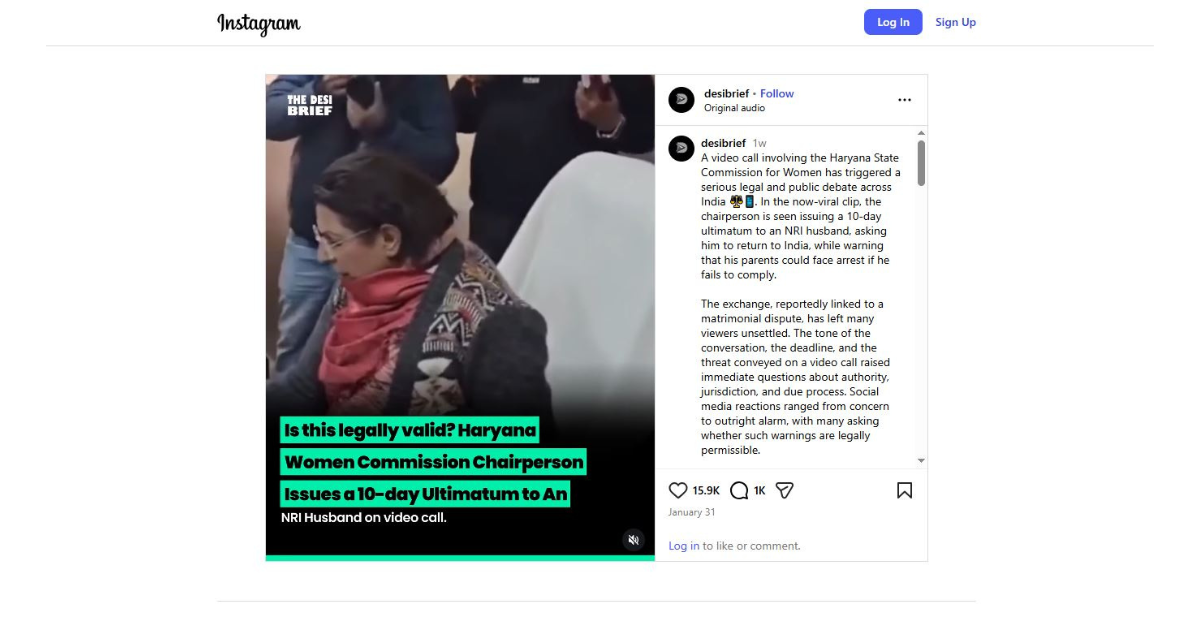
What Happened During the Commission Hearing
Recently, a video of a hearing conducted by the Haryana State Commission for Women went viral on social media, showing the chairperson interacting with individuals involved in a matrimonial dispute. The clip sparked widespread debate because some people perceived the commission’s actions as going beyond its legal role - especially when discussions appeared heated or confrontational.
At its core, the situation involved a family disagreement between spouses - a common type of matrimonial dispute in India - which was brought before a women’s commission for hearing. The video drew attention not because of extraordinary facts, but because many people were unsure what powers such commissions actually have.
Why Understanding the Legal Framework Matters
This matters because matrimonial disputes often involve serious issues—like domestic violence, harassment, or financial rights — where legal procedures and rights of both parties must be respected. If the public misunderstands the commission’s authority, it can lead to misplaced expectations and misinformation about what remedies are legally available. Clear knowledge helps people protect their rights and pursue the correct legal process.
Legal Powers and Limits of State Women’s Commissions
Statutory Mandate and Institutional Role
State Women’s Commissions (like Gujarat, Haryana, Rajasthan, Uttar Pradesh, etc.) are statutory bodies set up by state governments to promote women’s rights and welfare. These commissions are quoted as quasi-judicial, meaning they can conduct inquiries and hearings, but they are not courts of law like district courts or the High Court. Their main purpose is to address women’s issues, recommend policy changes, and help resolve complaints.
Investigative and Mediation Authority
Women’s Commissions can:
- Receive complaints from women about rights violations, harassment, or abuse.
- Summon individuals to explain their side of the story.
- Inquire into facts and gather statements.
- Counsel both sides and try to mediate a settlement.
- Recommend action to government agencies or police based on findings.
This means a commission can listen, ask questions, and issue recommendations, but cannot enforce penalties like a court. Their role is to facilitate and advocate rather than punish.
Boundaries of Enforcement Power
Importantly, commissions do not have the power to arrest, order imprisonment, or impose legal penalties on anyone. Arrest powers solely belong to law enforcement agencies and the judiciary. Commissions cannot issue enforceable orders like courts; they can only suggest, counsel, mediate, and recommend further action.
How Matrimonial Complaints Are Legally Processed
Filing and Registration of Complaints
If a woman (or any spouse) believes their rights have been violated within a marriage - such as through domestic violence - they can:
- File a complaint with the police (FIR).
- Approach the Protection Officer or Magistrate under the Protection of Women from Domestic Violence Act, 2005.
- Lodge a complaint with the Women’s Commission for support and recommendations.
Under the Protection of Women from Domestic Violence Act, 2005, domestic violence includes physical, emotional, economic or verbal abuse, and this law provides civil protections like protection orders, residence rights, and monetary relief - but it functions alongside, not within, criminal law.
Inquiry, Hearings, and Mediation
Once a complaint is filed with a commission:
- The commission may hear both parties.
- It may mediate to try to resolve the matter amicably.
- It can investigate facts and ask for documents or evidence.
These hearings are helpful for advising and recommending, but if the issue involves violations of criminal law (like assault or threats), the matter must move to the police or courts for enforcement.
Referral to Police or Courts
If the commission finds a possible legal violation, it can direct the complainant to:
- File a police FIR for criminal investigation.
- Approach a judicial magistrate for orders and legal relief.
- Take up civil remedies like maintenance, custody, or divorce proceedings in family court.
Thus, the commission often functions as a first contact point that guides people into the proper legal channels.
Arrest Authority and Due Process Under Indian Law
Who Has the Legal Power to Arrest
Under Indian law, only the police and the judiciary have legal authority to arrest a person suspected of a crime.
- Police can arrest based on lawful grounds and investigation.
- Courts can issue warrants for arrest after finding prima facie evidence.
Women’s commissions do not have any legal authority to arrest anyone, even in matrimonial disputes with alleged violence.
Procedural Safeguards for All Parties
When an arrest or criminal process begins, both sides enjoy legal protections, including:
- Right to legal counsel.
- Right to fair investigation.
- Right to be heard in court.
- Right to bail where applicable.
These safeguards exist to ensure fairness, due process, and justice under Indian law.
Limits on Action Against Family Members
Commissions cannot punish or hand down binding orders against family members or third parties in matrimonial disputes.
If violations occur, these allegations must be addressed through:
- Police investigation.
- Criminal prosecution.
- Judicial orders in family or criminal court.
Lawful Options Available in Cross-Border Matrimonial Disputes
Jurisdiction in NRI Cases
If a matrimonial dispute involves persons living abroad (e.g., Non-Resident Indians), the territorial limits of state agencies apply. A State Women’s Commission only has jurisdiction within its own Indian state, not outside India. For disputes crossing borders, remedies often involve:
- Filing cases in civil courts with international jurisdiction.
- Using service procedures recognized in India for serving notices abroad.
Coordination with Central Authorities
In some cases, central government agencies, diplomatic missions, or Indian embassies may assist with legal documentation, advice, and ensuring compliance with foreign jurisdictions.
Structured Legal Remedies for Compliance
For enforcement of court orders or legal rights in cross-border cases:
- One can approach family courts for divorce, maintenance, or custody orders that are enforceable domestically.
- Foreign judgments may be recognised under Indian law if requirements of reciprocity and jurisdiction are met.
Conclusion
The recent viral hearing involving a State Women’s Commission sparked public debate because many people were unclear about what such commissions can legally do. While Women’s Commissions play an important role in supporting women, addressing grievances, and facilitating mediation in matrimonial disputes, they are not courts of law and do not possess powers of arrest or punishment.
In short, Women’s Commissions are support institutions, not judicial authorities. For binding and enforceable relief, the proper forum remains the court of law.
Frequently Asked Questions (FAQs)
Can a State Women’s Commission order someone’s arrest?
No. A State Women’s Commission does not have the legal authority to arrest anyone. Only the police can make arrests under the Code of Criminal Procedure, and courts can issue arrest warrants.
Is a Women’s Commission the same as a court?
No. A Women’s Commission is a statutory body with quasi-judicial powers to conduct inquiries and make recommendations. It cannot pass binding judgments like a civil, criminal, or family court.
Are parties legally bound by the Commission’s recommendations?
Generally, recommendations are advisory in nature. They do not automatically have the force of a court order. Binding enforcement requires action through judicial authorities.
Can a Women’s Commission take action against family members in a matrimonial dispute?
The Commission can hear complaints and conduct inquiries involving family members, but it cannot impose penalties or criminal punishment. Any criminal liability must be determined by a court of law.
Do State Women’s Commissions have authority in NRI or foreign-based disputes?
Their jurisdiction is limited to their respective state within India. In cross-border disputes, parties may need to approach family courts, central authorities, or diplomatic channels for enforcement.
Is approaching a Women’s Commission mandatory before going to court?
No. It is optional. A person can directly approach the police or the court, depending on the nature of the dispute.