
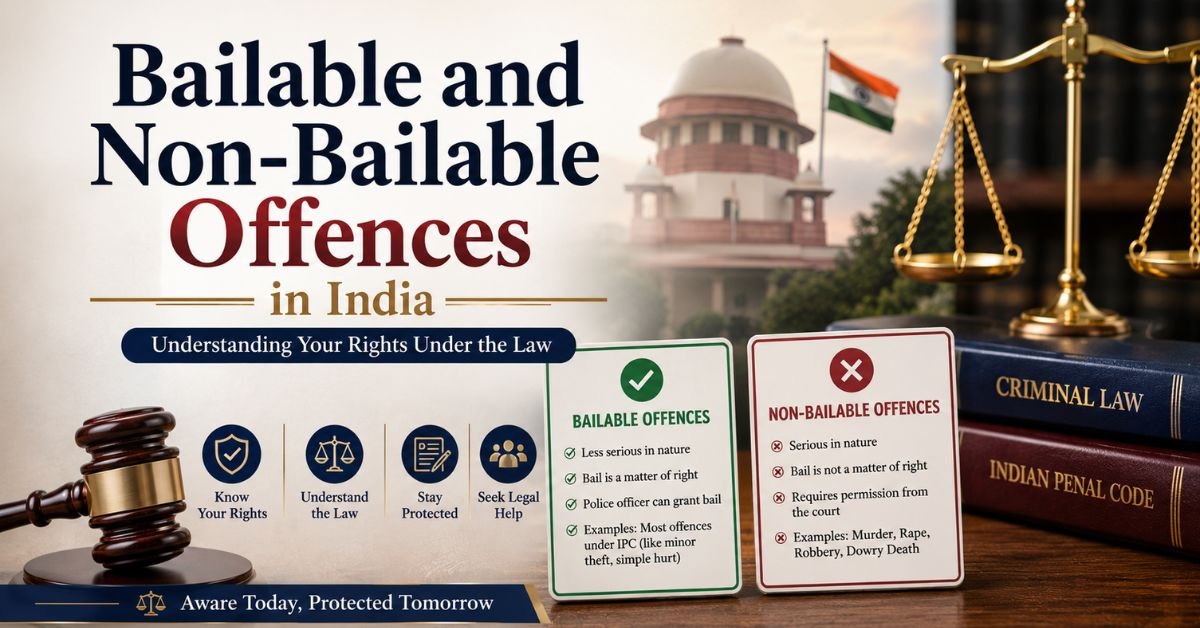
When someone is arrested in India, one question decides what happens in the crucial first hours: is the alleged crime a bailable or non-bailable offence? The answer determines whether bail is your legal right or something a court must be persuaded to grant. This guide explains the difference between bailable and non-bailable offences in plain language under India’s new criminal laws — the Bharatiya Nagarik Suraksha Sanhita, 2023 (BNSS) and the Bharatiya Nyaya Sanhita, 2023 (BNS) — with practical examples.
What Is a Bailable Offence?
A bailable offence is one where bail is a matter of right. If you are accused of a bailable offence, the police or the court must release you once you furnish the required bail bond or surety. The officer in charge of the police station cannot refuse. These are generally the less serious offences.
Key features of a bailable offence:
- Bail is granted as a right, not left to discretion.
- Bail can be given by the police at the station or by a court.
- Usually applies to offences punishable with imprisonment of less than three years, or with fine only.
What Is a Non-Bailable Offence?
A non-bailable offence is more serious, and here bail is not automatic. Bail becomes a matter of the court’s discretion — a Magistrate or Sessions Judge weighs the gravity of the crime, the strength of the evidence, and the risk that the accused may abscond or tamper with witnesses.
Key features of a non-bailable offence:
- Bail is discretionary and decided by a court, not the police.
- The court may grant bail with conditions, or refuse it altogether.
- Typically covers serious crimes punishable with three years or more, life imprisonment, or death.
Importantly, “non-bailable” does not mean bail is impossible. It simply means bail must be applied for and can be denied.
Bailable and Non-Bailable Offences: Key Differences
The practical differences between the two categories come down to five points:
- Right vs discretion: Bail is a right in a bailable offence; in a non-bailable offence it is the court’s discretion.
- Who grants bail: Police or court for bailable offences; only a court for non-bailable ones.
- Seriousness: Bailable offences are minor; non-bailable offences are serious.
- Punishment: Bailable offences usually carry under three years or a fine; non-bailable offences carry three years to life or death.
- Can bail be refused: Not if the bond is furnished in a bailable offence; yes, in a non-bailable offence.
How Do You Know Which Category an Offence Falls In?
Every offence in India is classified in the First Schedule of the BNSS, which lists each section of the law and states whether it is cognizable or non-cognizable and bailable or non-bailable. You can also check the relevant section of the BNS. As a rough rule of thumb, the more severe the punishment, the more likely the offence is non-bailable — but always confirm from the Schedule or consult an advocate, because there are exceptions.
Common Examples of Bailable and Non-Bailable Offences
Offences that are usually bailable include:
- Simple hurt
- Defamation
- Public nuisance
- Causing death by negligence (in many cases)
- Cheque bounce under Section 138 of the Negotiable Instruments Act
Offences that are usually non-bailable include:
- Murder and attempt to murder
- Rape and other serious sexual offences
- Kidnapping and abduction
- Dowry death
- Cruelty to a woman by her husband or his relatives (Section 85 of the BNS, earlier Section 498A of the IPC)
Two questions people ask most often:
- Is 498A (now Section 85 BNS) bailable? No. Cruelty by a husband or his relatives is a cognizable, non-bailable offence, so the accused must apply to a court for bail — often anticipatory bail.
- Is theft a bailable offence? Theft (Section 303 of the BNS) is generally treated as a non-bailable offence, although it is usually tried by a Magistrate.
Getting Bail in a Non-Bailable Case
If the offence is non-bailable, there are two main routes to freedom:
- Regular bail after arrest, applied for before the Magistrate or Sessions Court.
- Anticipatory bail before arrest, when you genuinely fear being booked in a non-bailable case. Our guide on anticipatory bail under the BNSS explains this in detail.
Before deciding, the court considers the nature of the accusation, the severity of the possible punishment, the evidence on record, the criminal history of the accused, and the likelihood of the accused fleeing or influencing witnesses.
Frequently Asked Questions
Can bail ever be denied in a bailable offence?
Generally no. If the offence is bailable and you furnish the bail bond, release is a right. Problems arise only if you breach bail conditions or are simultaneously involved in other, non-bailable matters.
Is bail a matter of right in a non-bailable offence?
No. In a non-bailable offence, bail is at the court’s discretion. Courts do grant it frequently, especially where the offence is not punishable with death or life imprisonment, but it is never automatic.
Who decides bail in a non-bailable case?
Only a court — usually the Magistrate or the Sessions Court, and in certain matters the High Court.
What are some examples of non-bailable offences?
Murder, attempt to murder, rape, kidnapping, dowry death, and cruelty under Section 85 of the BNS (formerly Section 498A IPC) are common examples of non-bailable offences.
Disclaimer: This article is intended for general information only and does not constitute legal advice. Whether a particular offence is bailable or non-bailable can depend on the exact section, the facts, and the amendments in force. For guidance on a specific case, please consult a qualified advocate.