
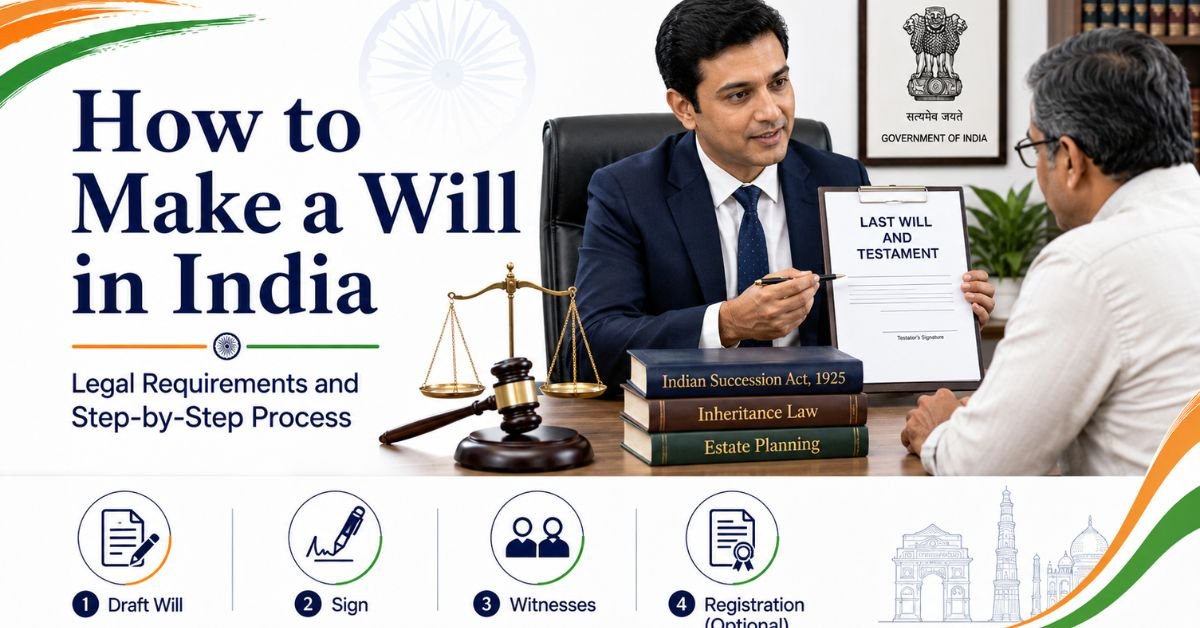
Knowing how to make a will in India is one of the simplest ways to protect your family from property disputes and court delays after you’re gone. Most Indians never write one, often assuming it needs a lawyer or heavy paperwork — but the law actually keeps the process fairly simple. Here’s who can make a will, what makes it legally valid, and the step-by-step process to draft, sign and register one.
What Is a Will Under Indian Law?
A will (or “testament”) is a legal declaration of how a person wants their property distributed after death. Wills made by Hindus, Buddhists, Sikhs, Jains, Christians and Parsis are primarily governed by the Indian Succession Act, 1925. Muslims are largely governed by their own personal law instead, under which a person can generally bequeath only up to one-third of their estate by will without the consent of their legal heirs.
Who Can Make a Will? Legal Requirements for a Valid Will
Anyone of sound mind who has attained the age of majority (18 years) can make a will. A will made under coercion, fraud, undue influence, or by someone who doesn’t understand the nature of the act is not valid.
Essential Conditions for a Valid Will
- Testamentary capacity: at least 18 years old and of sound mind when the will is made.
- Free will: made voluntarily, without pressure or fraud.
- In writing: oral wills are recognised only in very limited cases; a written will is always safer and easier to prove.
- Signed by the testator, or by someone else in their presence and under their direction.
- Attested by two witnesses under Section 63 of the Indian Succession Act — each must have seen the testator sign, or received a personal acknowledgment of the signature.
There’s no fixed format for a valid will, and no stamp duty is payable on it — it just has to clearly express the testator’s intent.
Step-by-Step Process: How to Make a Will in India
1. List Your Assets and Beneficiaries
List your movable and immovable assets — property, bank accounts, investments, jewellery, insurance — and decide who inherits what.
2. Appoint an Executor
Choose a trustworthy person to carry out your instructions after death, and ideally name an alternate executor too.
3. Draft the Will
Include your name and address, a declaration of sound mind, asset and beneficiary details, the executor’s name, the date, and a clause revoking any earlier wills. For anyone wondering how to write a will for property in India, mention the exact address, survey/plot number and each beneficiary’s share to avoid ambiguity later.
4. Sign and Get It Attested
Sign in the presence of two witnesses who are ideally not beneficiaries (a bequest to an attesting witness can be void in some cases). Each witness signs after watching the testator sign, or after the signature is acknowledged to them.
5. Register It (Optional but Recommended)
Registration isn’t compulsory, but it strengthens the will’s evidentiary value and makes it far harder to challenge later.
Can You Make a Will Without a Lawyer in India?
Yes. Many people search for how to make a will without a lawyer in India — and legally, you can draft and execute one yourself as long as it meets the conditions above. For a simple estate with no likely disputes, a self-drafted will can work. But for larger or complex estates — multiple properties, blended families, minor beneficiaries, or assets in different states — a lawyer’s review is worth it, since a poorly worded will is a common cause of family litigation. If cost is a concern, free legal aid is available through the National Legal Services Authority (NALSA).
How to Register a Will
Registration happens under the Registration Act, 1908, at the Sub-Registrar’s office having jurisdiction over where the testator resides or owns property:
- Visit with the original will and identity/address proof.
- The testator (and ideally the witnesses) should be present.
- Pay a nominal registration fee, which varies by state.
- The Sub-Registrar keeps a copy and returns the original.
A testator can also deposit a sealed will with the Registrar for safekeeping, to be opened only after death.
What Happens If You Die Without a Will?
If a person dies “intestate” (without a valid will), their property passes under the personal succession law that applies to them — the Hindu Succession Act, 1956 for Hindus, Buddhists, Sikhs and Jains; Muslim personal law for Muslims; and the Indian Succession Act’s intestate rules for Christians and Parsis. This often spreads the property across more heirs than the deceased may have wanted, and typically requires heirs to obtain a legal heir certificate or succession certificate before claiming bank accounts or transferring property. A will avoids this altogether by letting you decide in advance.
Wills for NRIs: A Quick Note
NRIs who own property in India often need two separate wills — one for Indian assets under Indian law, one for foreign assets — to avoid conflict-of-law issues and probate delays. If you’re an NRI with property here, our guide on NRI property purchase in India covers the related legal steps worth pairing with your estate planning.
Can a Will Be Changed or Cancelled?
Yes, at any time during the testator’s lifetime, as long as they remain of sound mind — by making a new will that revokes the earlier one, by executing a “codicil” (a formal amendment), or by physically destroying the original with clear intent to revoke it.
Frequently Asked Questions
Is it compulsory to register a will in India?
No. An unregistered will is just as legally valid as a registered one, provided it meets the signing and attestation requirements — registration only makes it harder to dispute.
Is probate of a will mandatory in India?
Only in limited situations — mainly for wills covering immovable property within the former presidency towns of Kolkata, Mumbai and Chennai. Elsewhere it’s generally not compulsory, though banks may sometimes ask for it. Rules vary by state, so confirm with a lawyer for your case.
Can a will be handwritten?
Yes. A handwritten (holograph) will is valid as long as it’s signed by the testator and attested by two witnesses — what matters legally is meeting those conditions, not whether it’s typed or handwritten.
What is a “living will” in India?
It’s different from a regular will — an advance medical directive stating a person’s wishes on end-of-life treatment if they become incapacitated. The Supreme Court has recognised living wills in the context of passive euthanasia, subject to a defined procedure; this is a specialised area needing specific legal guidance.
Does a will need to be stamped or notarised?
No. A will doesn’t require stamp duty, and notarisation is not a legal requirement for validity — the essential requirements are only the testator’s signature and attestation by two witnesses.
Disclaimer: This article is for general informational purposes only and does not constitute legal advice. Laws relating to wills, succession and registration can vary by state and personal circumstance. Please consult a qualified advocate before drafting, signing or acting upon any will.