
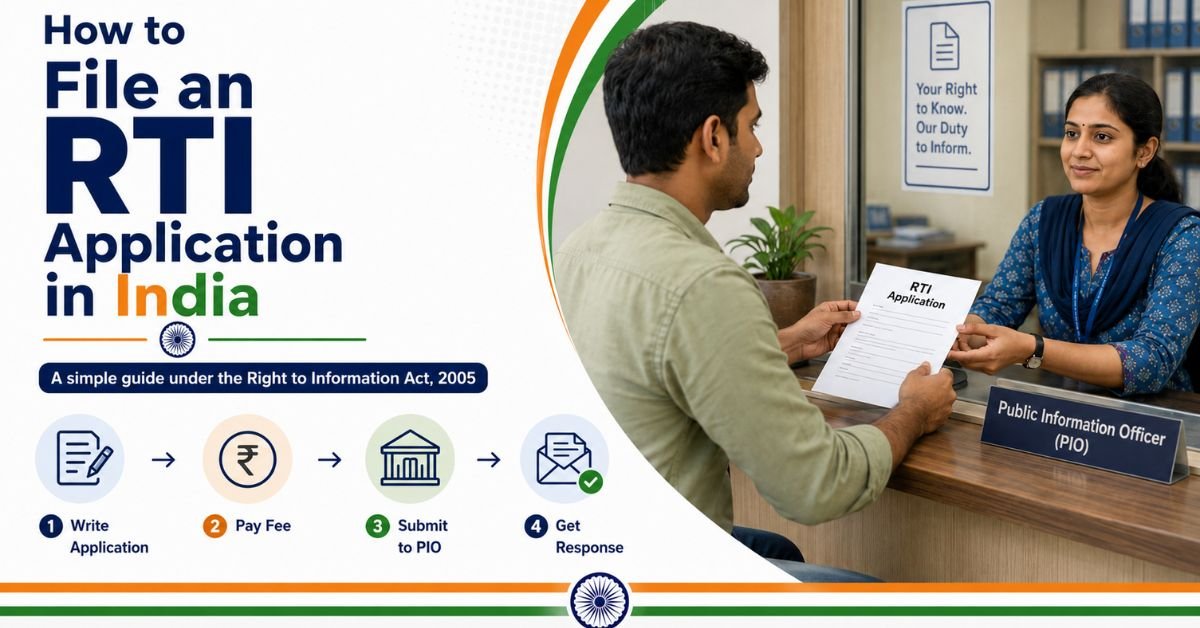
Filing an RTI application is one of the simplest ways for an ordinary citizen to hold a government office accountable. Under the Right to Information Act, 2005, any Indian citizen can ask a public authority for information it holds — from the status of a pending pension file to the reasons behind a delayed municipal approval. This guide explains, step by step, how to file an RTI application in India, what it costs, the format to use, and what to do if you don’t get a reply on time.
What is the Right to Information Act, 2005?
The RTI Act, 2005 gives every citizen the legal right to request information from a “public authority” — central and state government departments, public sector undertakings, and bodies substantially funded by the government. It was enacted to promote transparency and reduce corruption in government functioning, and remains one of the most citizen-friendly laws in India.
Who Can File an RTI Application?
Any citizen of India can file an RTI application. You don’t need to explain why you want the information or hire a lawyer. The only conditions are:
- The applicant must be an Indian citizen (foreign nationals and companies generally cannot file in their own name).
- The request must be addressed to the correct Public Information Officer (PIO) of the relevant department.
- The prescribed fee must be paid, unless exempted (for example, applicants below the poverty line).
How to File an RTI Application in India
You can file an RTI application either online or offline, depending on whether the information relates to a Central Government department or a State Government department.
Filing an RTI Application Online
For Central Government ministries, departments, and public authorities, applications can be filed through the official RTI Online Portal maintained by the Department of Personnel & Training (DoPT):
- Register on the portal and select the relevant Ministry/Department and Public Authority.
- Draft your request, keeping it specific and under the prescribed word limit (usually 3,000 characters).
- Pay the fee online via net banking, debit/credit card, or UPI.
- Submit and save the registration number generated — use it to track your RTI application status later.
Note: the central RTI Online Portal cannot be used for State Government departments. Most states now run their own RTI portals; check your state’s official portal or file offline if none is available.
Filing an RTI Application Offline (By Post)
If online filing isn’t available for your department, send a written application by post or hand-deliver it to the PIO’s office, attaching a demand draft, postal order, or fee receipt. Keep a copy along with proof of dispatch for your records.
RTI Application Format and What to Include
There’s no single mandatory format prescribed under the Act itself, though most public authorities provide a suggested RTI application form. At a minimum, your application should contain:
- Your name and complete postal address (for correspondence).
- The name and address of the public authority/PIO the request is addressed to.
- A clear, specific description of the information sought — vague or overly broad requests are often rejected or delayed.
- Proof of fee payment.
- The language of the application, which should be in English, Hindi, or the official language of the area.
Keep your questions precise. Instead of “give me all details of road repair work in my area,” ask for specific documents — for example, “a copy of the work order and completion certificate for the road repair project on [street name], sanctioned in [month/year].”
RTI Application Fee
The standard RTI application fee for Central Government departments is ₹10, payable online or via postal order/demand draft in favour of the Accounts Officer of the public authority. Additional charges may apply for photocopies (typically ₹2 per page). Applicants Below the Poverty Line (BPL) are exempt from the fee on submitting a valid BPL certificate. State governments may prescribe slightly different fees, so check your state’s RTI rules before filing.
Timeline for Response
The PIO must respond to an RTI application within 30 days of receipt. If the request concerns a person’s life or liberty, the response must come within 48 hours. If the application is transferred to another public authority holding the information, the timeline runs from the date that authority receives it, extending the total period to about 35 days. If the PIO misses the deadline or gives an incomplete reply, the applicant can file a first appeal.
What If You Don’t Get a Response? Filing a First Appeal
If you get no response within 30 days, or are dissatisfied with the reply, file a first appeal with the First Appellate Authority (FAA) of the same public authority within 30 days of the deadline expiring. If that fails too, a second appeal can be filed with the Central Information Commission (CIC) or the relevant State Information Commission within 90 days. The Commission can direct the authority to furnish the information and can penalise the PIO for unreasonable delay or refusal.
This kind of persistent follow-up with government offices is common in Indian administrative processes — citizens verifying land or revenue records through RTI often need the same patience that buyers pursuing a property purchase in India need when chasing municipal document verification.
Exemptions — Information That Cannot Be Sought Under RTI
Not all information is disclosable. Section 8 of the RTI Act exempts certain categories, including:
- Information affecting the sovereignty, integrity, or security of India.
- Information forbidden by a court or that would amount to contempt of court.
- Trade secrets, intellectual property, and commercial confidence, unless larger public interest warrants disclosure.
- Personal information unrelated to any public activity, unless disclosure serves the larger public interest.
- Cabinet papers, though the material used to reach a decision must eventually be disclosed once the matter is complete.
RTI requests are often used alongside other document-based processes — for instance, families gathering records for succession matters may also need a Legal Heir Certificate from the local revenue authority, a separate application and verification process in its own right.
Frequently Asked Questions
Can I file an RTI application anonymously?
No. You must give your name and a valid postal address so the PIO can respond. Your identity isn’t disclosed to third parties, and you don’t need to justify why you want the information.
How much does it cost to file an RTI application online?
For Central Government departments, the standard fee is ₹10, payable through the RTI Online Portal via net banking, cards, or UPI. Small additional charges may apply for photocopies.
What happens if the PIO does not reply within 30 days?
You can file a first appeal with the First Appellate Authority of the same department, followed by a second appeal to the Central or State Information Commission if unresolved.
Can I file an RTI application for information about a private company?
Generally no, since the Act applies only to “public authorities.” If a private body receives substantial government funding, or a government department holds relevant records about it, you may be able to seek that specific information.
Is there a difference between filing RTI for Central and State government matters?
Yes. Central Government applications go through the national RTI Online Portal, while State Government matters must be filed through the respective state’s RTI portal or sent offline, as state departments aren’t covered by the central portal.
Disclaimer: This article is for general informational purposes only and does not constitute legal advice. RTI rules and fee structures can vary slightly between states and public authorities. For guidance specific to your situation, please consult a qualified advocate or refer to the official Right to Information Act, 2005 resources at rti.dopt.gov.in.