
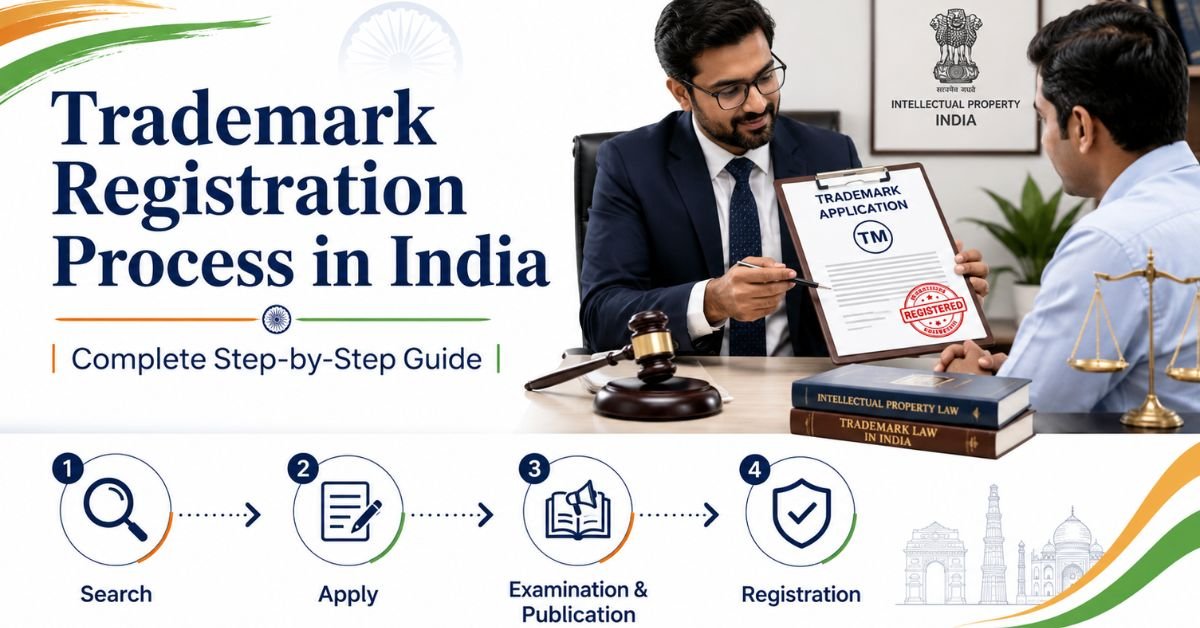
The trademark registration process in India lets individuals, startups and companies legally protect their brand name, logo, or slogan from being copied or misused by competitors. Once registered under the Trade Marks Act, 1999, a trademark gives the owner exclusive nationwide rights to use the mark for the goods or services it is registered under, along with the legal power to take action against infringers. This guide walks you through the complete step-by-step process, the documents you need, the government fees involved, and how long registration typically takes.
What Is a Trademark and Why Register It?
A trademark is any word, name, symbol, logo, sound, or combination of these that distinguishes your goods or services from those of others. Using a mark in business gives you limited “common law” rights, but registration under the Trade Marks Act, 1999 is what makes those rights enforceable across India. A registered trademark:
- Gives you the exclusive legal right to use the mark for your registered class of goods/services
- Allows you to use the ® symbol and sue for infringement (not just passing off)
- Becomes a valuable, transferable business asset that can be licensed or sold
- Deters others from adopting a deceptively similar name or logo
Legal Framework Governing Trademarks in India
Trademark registration in India is governed primarily by the Trade Marks Act, 1999 and the Trade Marks Rules, 2017, administered by the Office of the Controller General of Patents, Designs and Trade Marks (CGPDTM) under the Ministry of Commerce and Industry. All applications, examinations, oppositions, and renewals are processed through this office, and applicants can track filings on the official IP India portal.
Step-by-Step Trademark Registration Process in India
Step 1: Conduct a Trademark Search
Before applying, search the IP India public trademark database to check whether an identical or deceptively similar mark already exists in your chosen class. Skipping this step is one of the most common reasons applications later face objections or oppositions.
Step 2: Choose the Right Trademark Class
India follows the international Nice Classification system, which divides goods and services into 45 classes (1–34 for goods, 35–45 for services). Selecting the correct class of trademark in India is critical — an application filed under the wrong class will not protect your brand in the category that actually matters to your business, and amending the class later can be difficult.
Step 3: File the Trademark Application (Form TM-A)
The application is filed online through the IP India e-filing portal using Form TM-A, along with the prescribed fee. If a trademark agent or attorney is filing on your behalf, a Power of Attorney (Form TM-48) authorizing them must be submitted along with the application — the same underlying principle used when authorising any representative to act for you, as explained in our guide on Power of Attorney in India.
Step 4: Examination by the Registrar
The Registrar examines the application for distinctiveness and checks it against existing marks. If objections are raised, the applicant gets an opportunity to respond in writing or through a hearing before the Registrar decides whether to accept or refuse the mark.
Step 5: Publication in the Trademark Journal
Once accepted, the mark is published in the Trade Marks Journal for four months. During this period, any third party who believes the mark conflicts with their own rights can file an opposition.
Step 6: Registration and Certificate
If no opposition is filed (or an opposition is decided in the applicant’s favour), the Registrar issues the trademark registration certificate. From this point, the mark is officially registered and the owner can use the ® symbol.
Documents Required for Trademark Registration
The documents required for trademark registration in India vary slightly depending on the applicant type, but generally include:
- Applicant’s name, address, and business/incorporation details
- A clear representation (JPEG) of the logo or wordmark, if applicable
- Proof of claimed use of the mark, such as invoices, if applying on a “used since” basis
- Udyam/MSME or Startup India recognition certificate, where applicable, to avail fee concessions
- Signed Form TM-48 (Power of Attorney), if filed through a trademark agent or attorney
- Identity/address proof of the applicant (individual, partnership, LLP, or company, as applicable)
Cost of Trademark Registration in India
The government filing fee is broadly ₹4,500 per class for individuals, sole proprietors, startups, and MSMEs filing electronically, and ₹9,000 per class for other applicants — but always confirm the current fee on the official IP India portal, as fees are revised periodically. Agent/attorney fees, if engaged, are charged separately.
How Long Does It Take, and How Long Is It Valid?
With no objections or opposition, registration typically takes 8–12 months from filing; a contested application can take well over a year. Once registered, a trademark is valid for 10 years from the filing date and can be renewed indefinitely for further 10-year terms, provided renewal is filed before expiry (a grace period with surcharge is also available). Missing renewal can get the mark removed from the register.
What Happens If You Don’t Register Your Trademark?
An unregistered mark isn’t entirely unprotected — the common law remedy of “passing off” may still apply if you can prove prior use and reputation. But passing-off cases are harder and costlier to prove than straightforward infringement claims under a registered mark, so registration is strongly advisable for any brand you intend to build on. If a registered trademark owner passes away, their heirs will typically need a Legal Heir Certificate or succession documentation to have the rights transmitted in their name at the registry.
Frequently Asked Questions
Can I register a trademark myself without a lawyer?
Yes, you can file directly through the IP India e-filing portal. Many applicants still use a trademark agent or attorney because the examination and opposition stages involve procedural nuances that benefit from professional handling.
What is the difference between TM, ®, and ©?
“TM” is an unregistered claim that anyone can use. The ® symbol is legal only after official registration with the Trade Marks Registry. “©” is copyright — a separate right protecting creative works like writing or software, not brand names or logos.
Can I file a trademark application for a business that hasn’t started yet?
Yes, on a “proposed to be used” basis, though actual use should begin within a reasonable time to avoid the registration becoming vulnerable to a non-use cancellation later.
What happens if someone opposes my trademark application?
The matter proceeds to a quasi-judicial hearing before the Registrar, where both sides file evidence and arguments. Respond within the prescribed timelines, or the application may be treated as abandoned.
Is trademark registration valid outside India?
No, a mark registered only in India is protected within India. For international protection, applicants can use the Madrid Protocol for a single application covering multiple member countries, or file separately in each country of interest.
Disclaimer: This article is for general informational purposes only and does not constitute legal advice. Trademark laws and government fees are subject to change, and outcomes depend on the specific facts of each case. Please consult a qualified advocate or registered trademark agent for advice specific to your situation.