
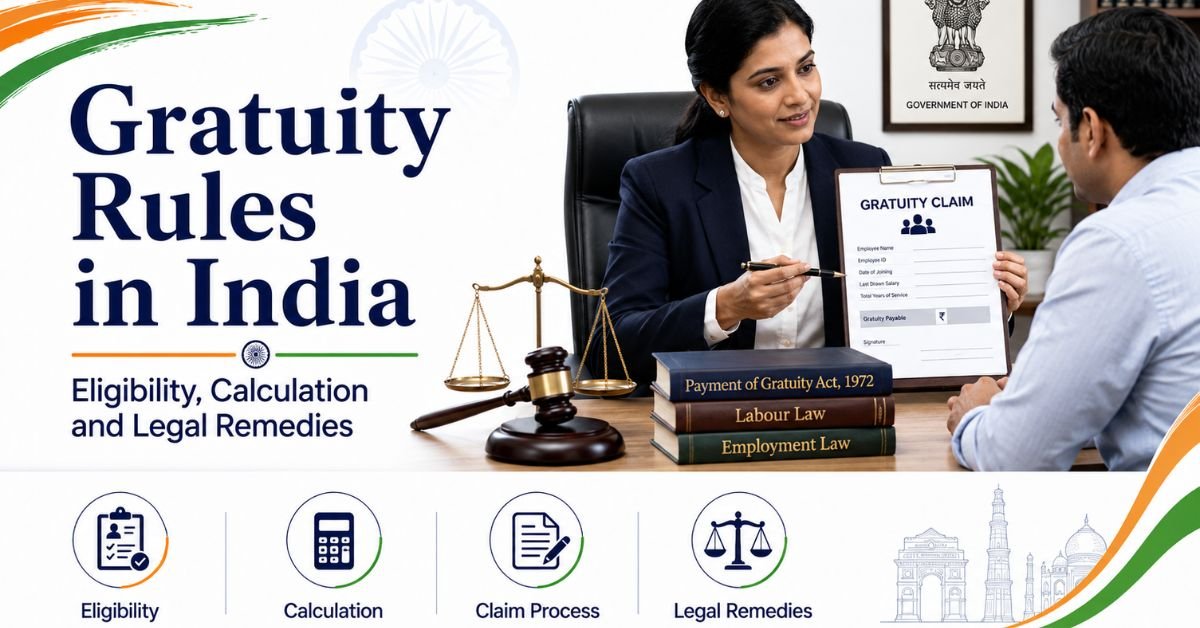
Gratuity rules in India are governed primarily by the Payment of Gratuity Act, 1972, a statute designed to reward employees for long and continuous service by giving them a lump-sum payment when they leave a job through retirement, resignation, or in unfortunate cases, death or disablement. If you are a salaried employee in the private or government sector, understanding these rules can help you know exactly what you are owed — and what to do if an employer refuses to pay.
What Is Gratuity and Which Employees Are Covered?
Gratuity is a statutory retirement benefit paid by an employer to an employee as a token of appreciation for services rendered. Under the Payment of Gratuity Act, 1972, it applies to every factory, mine, oilfield, plantation, port, railway company, shop, or establishment employing 10 or more persons on any day in the preceding 12 months. Once an establishment is covered, it continues to be covered even if the number of employees later falls below 10.
The gratuity policy in India is not limited to permanent staff — it also extends to employees on contract, provided they satisfy the eligibility conditions discussed below.
Eligibility Criteria for Gratuity Under Indian Law
Gratuity eligibility in India is largely determined by continuity of service. An employee is generally entitled to gratuity if they have rendered at least five years of continuous service with the same employer. However, this five-year requirement is relaxed in certain situations:
- Death of the employee (gratuity is paid to the nominee or legal heirs regardless of the length of service)
- Disablement due to accident or disease that renders the employee unfit to continue working
- Termination of a fixed-term employment contract, superannuation, or retirement
For the purpose of eligibility for gratuity in India, “continuous service” includes periods of authorised leave, sickness, accident, lay-off, strike (not illegal), or lock-out, as well as maternity leave up to the period permitted under law.
How Is Gratuity Calculated? The Formula
The rules for gratuity calculation differ slightly depending on whether the establishment is covered under the Act or not.
For Employees Covered Under the Act
The standard formula is:
Gratuity = (Last drawn salary × 15 × number of years of service) ÷ 26
Here, “last drawn salary” means basic salary plus dearness allowance, and 26 represents the number of working days in a month. Any service period of more than six months in the final year is rounded up to a full year for the calculation of gratuity for private employees.
For Employees Not Covered Under the Act
Some employers voluntarily pay gratuity even if the establishment is not strictly covered. In such cases, the calculation typically uses 30 days instead of 26 as the divisor, though this depends on company policy or the applicable employment contract.
The maximum gratuity amount payable under the Act is currently capped at ₹20 lakh; employers may pay a higher ex-gratia amount voluntarily, but it will not enjoy the same statutory protection.
Is Gratuity Taxable? Tax Exemption Limits
Gratuity received by government employees is fully exempt from income tax. For employees in the private sector covered under the Payment of Gratuity Act, the exemption under Section 10(10) of the Income Tax Act, 1961 is available up to the least of: the actual gratuity received, ₹20 lakh, or the amount calculated using the statutory formula above. Employees should refer to the Income Tax Department’s official portal for the current exemption limits and filing guidance, as these thresholds are revised periodically by the government.
When Can an Employer Withhold or Forfeit Gratuity?
Gratuity is a hard-earned right, but the law does allow an employer to withhold or forfeit it in limited circumstances:
- If the employee’s services were terminated for riotous or disorderly conduct, or an act of violence
- If the employee was terminated for an act constituting an offence involving moral turpitude, committed during the course of employment
- To recover damages caused by the employee’s wilful negligence or misconduct, limited to the extent of the loss caused
Forfeiture cannot be arbitrary — it requires a proper disciplinary process and, in many cases, a judicial or departmental finding against the employee. Simply resigning or being asked to leave for performance reasons does not disqualify an employee from receiving gratuity.
What to Do If Your Employer Refuses to Pay Gratuity — Legal Remedies
If an employer delays or refuses to pay gratuity, the law provides a clear remedy:
- Send a written application (Form I) to the employer within 30 days of the gratuity becoming payable.
- If the employer does not respond or refuses payment, file an application before the Controlling Authority appointed under the Act — usually an officer in the Labour Department of the relevant state.
- The Controlling Authority can direct the employer to pay the gratuity along with interest for the period of delay, and can also impose a penalty for unjustified non-payment.
- An appeal against the Controlling Authority’s order can be filed before the appropriate government or appellate authority within 60 days.
Where the employee is a nominee or legal heir claiming gratuity after the death of the employee, it is often useful to first secure a legal heir certificate, since employers frequently ask for proof of legal heirship before releasing dues to family members. Government employees who are unsure about the status of their gratuity claim can also consider filing an RTI application with the concerned department to obtain official information on the processing of their claim.
Frequently Asked Questions
Is gratuity payable before completing 5 years of service?
Generally no, unless the employee dies or is rendered permanently disabled while in service, in which case the five-year requirement does not apply.
Can an employer deny gratuity if an employee resigns?
No. Resignation after completing five years of continuous service does not affect gratuity eligibility, unless forfeiture applies due to proven misconduct as outlined under the Act.
What is the time limit to claim gratuity after it becomes due?
An employee should apply within 30 days of gratuity becoming payable, though claims filed after this period are often still accepted if there is a reasonable explanation for the delay.
Is there a difference between gratuity rules for government and private employees?
The core eligibility and calculation principles are similar, but government employees’ gratuity is governed by separate pension rules and enjoys full tax exemption, while private sector gratuity is capped and taxed as per Section 10(10) of the Income Tax Act.
Can gratuity be paid in installments?
The Act does not provide for gratuity to be paid in installments — it is meant to be paid as a lump sum within 30 days of it becoming due, failing which interest becomes payable.
Disclaimer: This article is intended for general informational purposes only and does not constitute legal advice. Gratuity rules can vary based on specific facts, state amendments, and company policy. Readers are advised to consult a qualified advocate or labour law expert for advice specific to their situation.