
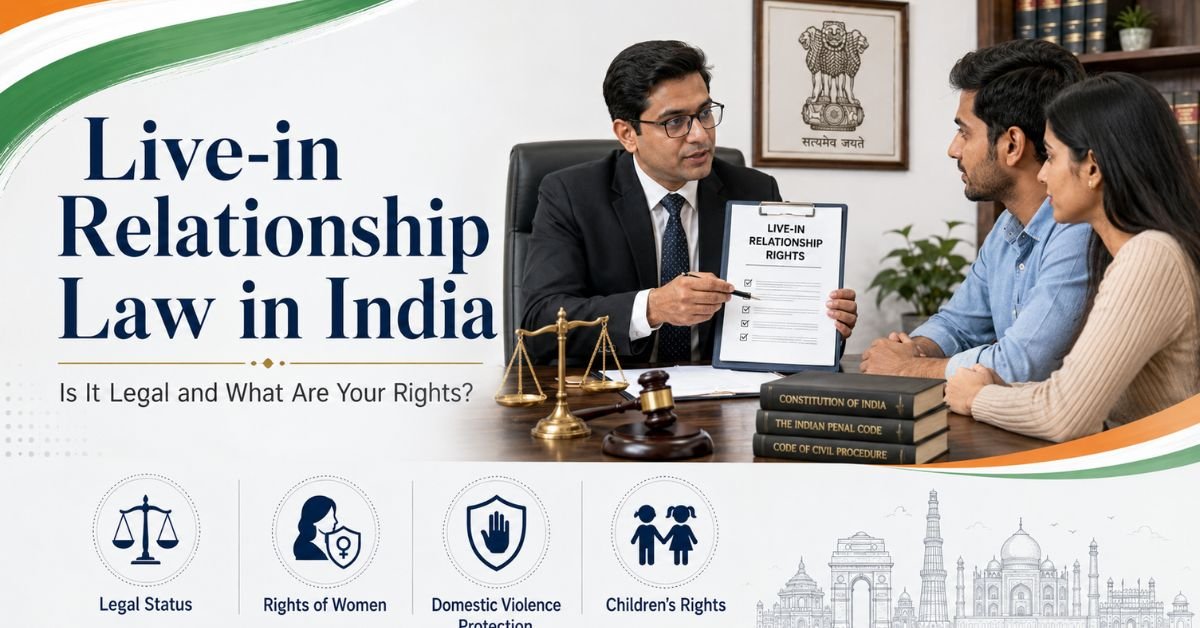
The live-in relationship law in India has evolved almost entirely through court judgments rather than a single dedicated statute. More couples today are choosing to live together without marriage, and this raises real questions: is it legal, what happens if the relationship breaks down, and do partners or their children have any rights? This guide explains where Indian law currently stands, what protections exist, and what practical steps couples can take to safeguard themselves.
Is a Live-in Relationship Legal in India?
Yes. Living together without marriage between two consenting adults is not a criminal offence in India. The Supreme Court has repeatedly held that the right to live together is part of the right to life and personal liberty under Article 21 of the Constitution. There is no specific “live-in relationship act in India” — instead, courts have built up protections through a series of judgments and by reading live-in couples into existing family welfare legislation.
That said, legality does not mean equivalence to marriage. A live-in partner does not automatically get the same legal status as a spouse under personal laws (such as succession or maintenance under matrimonial statutes), unless a court specifically extends a particular protection to the relationship.
What the Courts Have Said
Indian courts have consistently examined live-in relationships through the lens of whether the couple was in a “relationship in the nature of marriage” — meaning the couple held themselves out to society as spouses, lived together for a significant period, pooled finances, and were of legal age and free to marry. Where this test is satisfied, courts have extended several protections that would otherwise apply only to married couples, particularly under the Protection of Women from Domestic Violence Act, 2005, which expressly recognises relationships “in the nature of marriage” alongside formal marriages.
Where the relationship does not meet this threshold — for example, a short-term or clearly casual arrangement — courts have been reluctant to extend spousal protections.
Rights of Women in a Live-in Relationship
Protection from Domestic Violence
A woman in a live-in relationship that qualifies as being “in the nature of marriage” can seek protection orders, residence rights, and other remedies under the Protection of Women from Domestic Violence Act, 2005, just as a married woman can. This includes protection from physical, emotional, verbal, sexual, and economic abuse by her partner.
Right to Maintenance
Courts have, in several cases, allowed maintenance claims by women in long-term live-in relationships that resemble marriage, treating them on a similar footing to a deserted wife for the limited purpose of preventing destitution. However, this is decided case by case, and a short or casual live-in arrangement is unlikely to qualify.
Rights of Children Born Out of a Live-in Relationship
Children born to couples in a live-in relationship are treated as legitimate under Indian law, and courts have affirmed their right to inherit their parents’ property. This is an important protection, and it interacts closely with succession procedures — for instance, families often still need a legal heir certificate to establish inheritance rights when a parent passes away without a will.
Registration and State-Specific Rules
Most of India has no mandatory registration requirement for live-in relationships. However, this is changing in some states. Uttarakhand, through its Uniform Civil Code enacted in 2024, became the first state to require couples in a live-in relationship to register their relationship with the local registrar, with penalties for non-compliance. Couples living in or moving to Uttarakhand should check the current registration rules before assuming the general national position applies to them.
Practical Protection: Cohabitation Agreements
Because live-in relationships fall outside most codified matrimonial law, partners often have far less clarity than married couples about property division, financial contributions, or support if the relationship ends. A written cohabitation agreement — setting out how shared expenses, jointly acquired property, and financial contributions will be handled — is not mandatory, but it can reduce disputes considerably and serves as useful evidence of the couple’s intentions if a dispute later reaches court.
Live-in Relationships and Criminal Law
Live-in relationships themselves are not an offence. However, couples should be aware that certain related conduct can attract criminal liability under the Bharatiya Nyaya Sanhita, 2023 (BNS), which replaced the Indian Penal Code from July 2024 — for example, provisions dealing with sexual intercourse obtained through a false promise of marriage or deceit. If a dispute involves allegations of domestic violence, cruelty, or such deceit, it is advisable to consult an advocate promptly, and where family court proceedings are also involved — such as a parallel divorce or separation matter — to coordinate the civil and criminal remedies carefully.
Frequently Asked Questions
Is live-in relationship legal in India for unmarried couples?
Yes. Two consenting adults who are legally free to marry can live together without marrying, and this is recognised as legal under Article 21 of the Constitution.
Can a woman claim maintenance from a live-in partner?
She may, if the relationship qualifies as being “in the nature of marriage” — typically a long-term, marriage-like cohabitation. Courts assess this on the specific facts of each case rather than applying an automatic rule.
Do live-in relationships need to be registered anywhere in India?
Registration is not mandatory across most of India. Uttarakhand is currently the only state that requires registration of live-in relationships under its Uniform Civil Code, 2024.
Are children born in a live-in relationship considered legitimate?
Yes. Indian courts have held that children born to live-in couples are legitimate and have inheritance rights in their parents’ property.
What legal protection does a woman have if her live-in partner is abusive?
She can seek relief under the Protection of Women from Domestic Violence Act, 2005, including protection orders and residence rights, provided the relationship meets the “nature of marriage” test.
Disclaimer: This article is intended for general informational purposes only and does not constitute legal advice. Live-in relationship disputes depend heavily on individual facts and evolving case law. Please consult a qualified advocate for advice specific to your situation.