
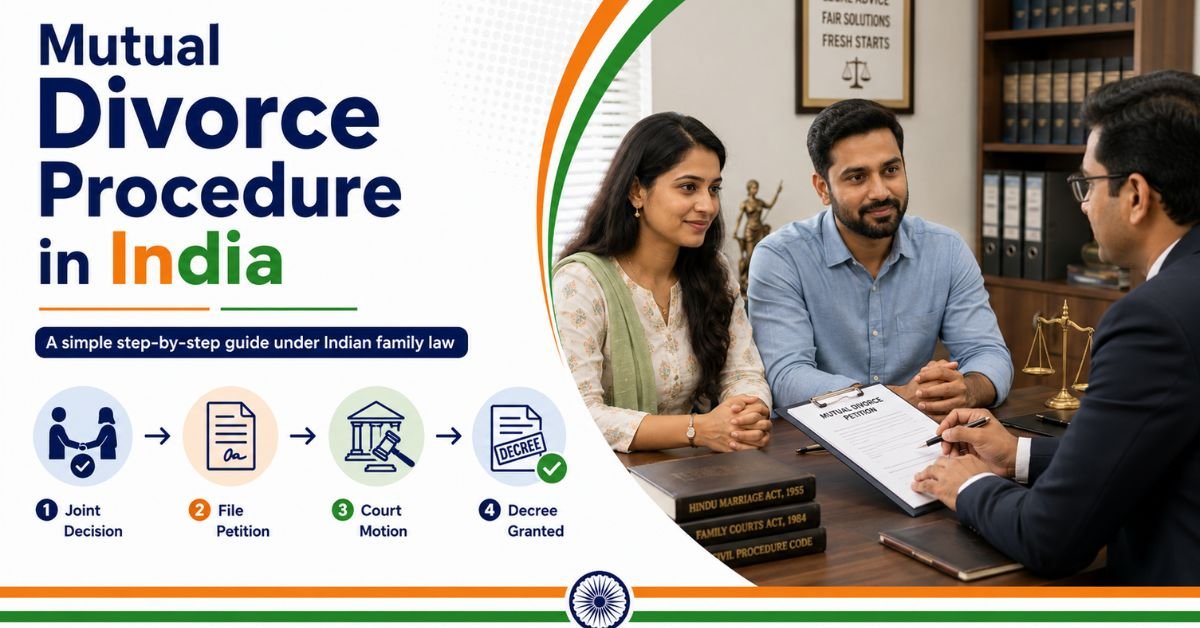
The mutual divorce procedure in India is the fastest and least adversarial way for a married couple to legally end their marriage when both spouses agree that the relationship cannot continue. Unlike a contested divorce, which can drag on for years over allegations of cruelty or desertion, a mutual consent divorce is built around agreement — on separation, on alimony, on custody — and is designed to move through the family court with minimum conflict. This guide explains the step-by-step process, the documents you need, the likely cost, and how long a mutual divorce actually takes in 2026.
What Is a Mutual Divorce Under Indian Law?
A mutual divorce (also called “divorce by mutual consent”) is a dissolution of marriage where both spouses jointly petition the family court, stating that they have been living separately, have been unable to live together, and have mutually agreed to end the marriage. The main legal provisions are:
- Section 13B of the Hindu Marriage Act, 1955 — for Hindus, Sikhs, Jains, and Buddhists.
- Section 28 of the Special Marriage Act, 1954 — for couples married under civil/interfaith law.
- Section 10A of the Indian Divorce Act, 1869 — for Christian couples.
- Muslim couples may achieve a similar outcome through khula or mubarat (mutual consent) under personal law, though the procedural framework differs from the statutory motions described below.
Conditions for Filing a Mutual Divorce
Courts will only entertain a mutual consent divorce petition if certain conditions are met:
- The couple must have been living separately for at least one year immediately before filing.
- They must show they have been unable to live together as husband and wife.
- Both parties must mutually agree that the marriage has broken down and should be dissolved.
- Both must agree on ancillary issues — alimony/maintenance, child custody, and division of property — since these terms are recorded in a settlement memorandum filed with the petition.
If a couple wants to file within one year of marriage, they generally cannot approach the court directly under Section 13B; they would first need to satisfy the court that the case involves exceptional hardship or depravity to permit an earlier petition. Where domestic disputes have already been raised with a statutory body before the couple reaches a mutual settlement, it also helps to understand the powers of Women’s Commissions in matrimonial disputes, since findings or conciliation efforts there can shape the terms eventually recorded in the divorce settlement.
Step-by-Step Mutual Divorce Procedure in India
Step 1: Draft and File the Joint Petition (First Motion)
Both spouses, through their advocate(s), jointly draft and file a divorce petition before the family court having jurisdiction (typically where the couple last resided together, where the marriage was solemnised, or where the wife currently resides). The petition includes a joint statement of facts and a settlement agreement covering alimony, custody, and asset division. Case status, hearing dates, and orders can usually be tracked online through the official e-Courts India portal.
Step 2: Recording of Statements and First Motion Order
Both spouses appear before the court and their statements are recorded on oath, confirming that the petition is filed voluntarily and without coercion. The court then passes the First Motion order.
Step 3: The Statutory Cooling-Off Period
After the First Motion, the law provides for a “cooling-off” period of six months (up to 18 months) before the Second Motion can be filed, giving the couple a chance to reconsider. The Supreme Court has held this waiting period is directory, not mandatory — family courts may waive it where all disputes, including maintenance and custody, are genuinely settled and reconciliation is not possible.
Step 4: Second Motion and Final Hearing
If both spouses still wish to proceed after the cooling-off period (or after it is waived), they file the Second Motion and their statements are recorded again to confirm the consent has not been withdrawn.
Step 5: Decree of Divorce
Once satisfied that the consent is genuine and the settlement terms are fair, the family court passes a decree of divorce, legally dissolving the marriage. Either spouse may remarry only after this decree is granted (and, in some cases, after the appeal period lapses).
Documents Required for Mutual Divorce
- Marriage certificate (or proof of marriage, such as wedding photographs/invitation card if a certificate was never issued)
- Address proof of both spouses
- Passport-size photographs of both parties
- Details of profession and income (salary slips, ITR, or income affidavit) of both spouses
- Evidence of separation (e.g., separate residence proof) for the statutory period
- Settlement agreement covering alimony, custody, and property division
- Details of family background and relationship of parties
How Long Does a Mutual Divorce Take?
A mutual divorce typically takes six months to a little over a year from filing to decree, depending on whether the court waives the cooling-off period. Where it is waived, cases can conclude within weeks of the First Motion; where it is not, expect roughly 6–8 months at minimum. Most delays come from court backlogs or one spouse delaying the Second Motion, so stay in touch with your advocate about hearing dates.
Cost of a Mutual Divorce in India
Court fees are nominal — typically a few hundred to a couple of thousand rupees, depending on the state. The larger cost is the advocate’s fee, which varies by city and by how complex the settlement is (especially where alimony, property, or custody need to be worked out before filing). Filing without a lawyer is technically possible, but family courts strongly recommend legal representation to ensure the settlement agreement is drafted correctly and both parties’ rights are protected.
Mutual Divorce Under the Special Marriage Act and Other Personal Laws
Couples married under the Special Marriage Act, 1954 follow a similar two-motion process under Section 28 of that Act, while Christian couples proceed under Section 10A of the Indian Divorce Act, 1869. Lawmakers have also debated widening the grounds for divorce — the Marriage Laws (Amendment) Bill proposed letting a single spouse seek dissolution for irretrievable breakdown after three years of separation, though this has not been enacted. Whichever statute applies, the core idea — consent recorded before the court, a fair settlement, and judicial oversight — remains the same.
Frequently Asked Questions
Can a mutual divorce be filed without a lawyer?
Legally, yes — there is no bar on self-representation. In practice, drafting an enforceable settlement agreement without legal guidance is risky, so most couples engage an advocate at least to prepare the petition and settlement terms.
What is the cooling-off period, and can it be waived?
It is the six-month gap between the First and Second Motions under Section 13B, meant to allow reconciliation. Courts often waive it where all disputes are genuinely settled and reconciliation is clearly not possible.
Can mutual divorce be filed within one year of marriage?
Generally no — Section 13B and equivalent provisions require the couple to have lived separately for at least one year before filing, unless the petitioner shows exceptional hardship or depravity.
What happens if one spouse withdraws consent before the decree?
Either spouse can withdraw consent before the Second Motion is heard and the decree passed. If that happens, the joint petition fails, and the parties would need to pursue a contested divorce on other grounds.
Is paying maintenance or alimony mandatory in a mutual divorce?
There is no fixed formula — the amount, if any, is whatever the spouses agree upon and record in their settlement, subject to the court finding it fair, particularly where children are involved.
Disclaimer: This article is for general informational purposes only and does not constitute legal advice. Laws and procedures may vary by state and change over time. For advice specific to your situation, please consult a qualified advocate.