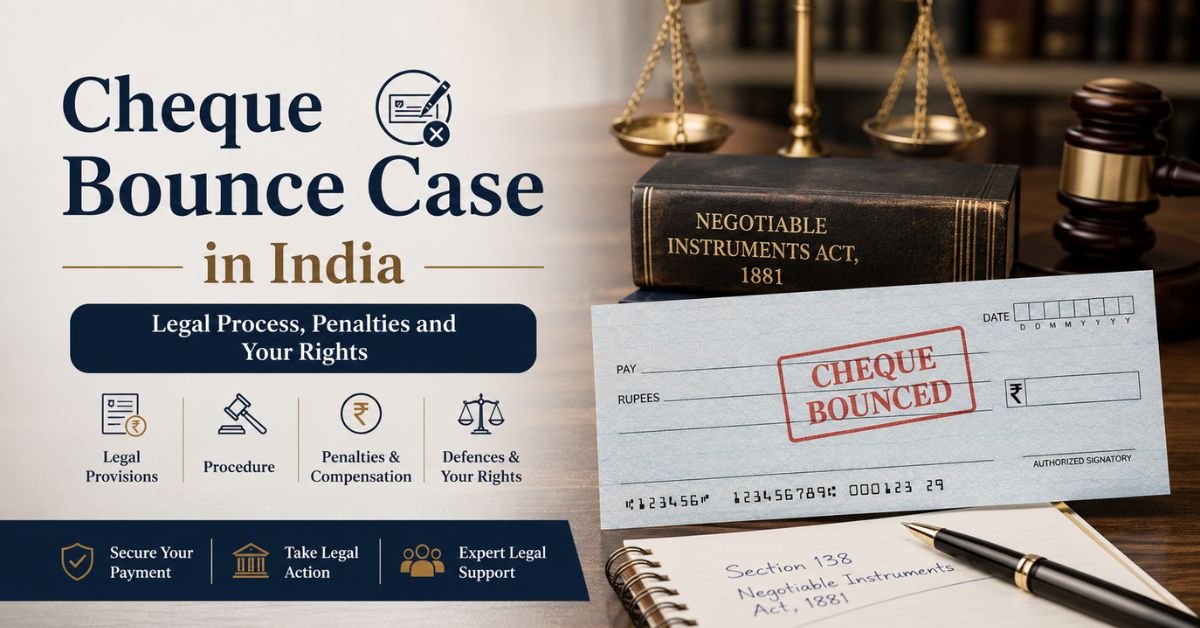
A cheque bounce case arises when a cheque issued to settle a debt or liability is returned unpaid by the bank, and the payee decides to take legal action against the person who issued it. In India, this is one of the most common financial disputes that ends up in court, governed primarily by Section 138 of the Negotiable Instruments Act, 1881. If you have received a bounced cheque, or if you are facing a complaint after your own cheque was dishonoured, understanding the process, penalties, and defences involved can save you time, money, and unnecessary stress.
What Is a Cheque Bounce Case?
A cheque “bounces” or is “dishonoured” when the bank refuses to honour it, most often because of insufficient funds, a mismatched signature, or an error in the amount written in words and figures. When this happens for a cheque issued towards the discharge of a legally enforceable debt, Section 138 of the Negotiable Instruments Act treats it as a punishable offence. This makes a cheque bounce case somewhat unusual in Indian law — it is a criminal complaint, but one that is largely aimed at recovering money rather than simply punishing the offender.
Common Reasons a Cheque Gets Dishonoured
- Insufficient balance in the drawer’s account
- Signature mismatch with bank records
- Overwriting, or a mismatch between the amount in words and figures
- Post-dated cheque presented before its date
- Account closed or frozen by the bank
- Stop-payment instruction issued by the drawer
Cheque Bounce Case Process in India: Step by Step
Step 1: The Cheque Is Returned by the Bank
When a cheque is dishonoured, the payee’s bank issues a “cheque return memo” stating the reason for dishonour, such as “funds insufficient.” This memo is the starting point of any cheque bounce case and must be preserved carefully as evidence.
Step 2: Sending a Legal Demand Notice
The payee must send a written legal notice to the drawer of the cheque within 30 days of receiving the return memo, demanding payment of the cheque amount. This is a mandatory step — a complaint filed without a valid notice is not maintainable in court.
Step 3: Waiting Period and Filing the Complaint
The drawer gets 15 days from receipt of the notice to make the payment. If payment is not made within this period, the payee can file a criminal complaint before the Magistrate’s court within 30 days of the cause of action arising (i.e., after the 15-day period expires).
Step 4: Court Process
Cheque bounce cases are tried as summons cases, following the criminal procedure now set out under the Bharatiya Nagarik Suraksha Sanhita, 2023 (BNSS), which replaced the Code of Criminal Procedure, 1973, from July 2024. The court issues summons to the accused, records evidence, and proceeds to a decision after hearing both sides. Many courts also encourage settlement through Lok Adalats or mediation, since the underlying dispute is usually about recovery of money.
Cheque Bounce Penalty: Fine, Imprisonment and Compensation
On conviction under Section 138, the court can impose:
- Imprisonment for a term which may extend to two years, or
- A fine which may extend to twice the amount of the cheque, or both
- Interim compensation of up to 20% of the cheque amount, which the court may direct the accused to pay during the trial itself
In practice, courts frequently focus on ensuring the complainant is compensated for the cheque amount rather than imposing a jail term, especially where the accused is willing to pay.
Is a Cheque Bounce Case Criminal or Civil?
A cheque bounce case is technically a criminal proceeding, but it is a bailable and compoundable offence, meaning the accused is normally entitled to bail and the parties can settle the matter at any stage, even after conviction, with the court’s permission. This dual character — criminal in form but civil in substance — is what makes cheque bounce disputes different from most other criminal offences in India.
Time Limit to File a Cheque Bounce Case
Strict timelines apply at every stage:
- Notice must be sent within 30 days of the cheque return memo
- The drawer has 15 days to pay after receiving the notice
- The complaint must be filed within 30 days after the 15-day payment window lapses
Missing these deadlines can be fatal to the case, although courts have limited discretion to condone delay in filing if sufficient cause is shown.
Defences Available to the Accused
A person accused in a cheque bounce case is not without options. Common defences include showing that there was no legally enforceable debt, that the cheque was issued as security and not for a due liability, that the notice was not validly served, or that the complaint was filed outside the limitation period. If the matter also involves a risk of arrest, the accused may explore protections such as anticipatory bail, though in most cheque bounce matters courts grant regular bail readily since the offence is bailable.
Frequently Asked Questions
Can a cheque bounce case be settled out of court?
Yes. Since the offence is compoundable, the parties can settle at any stage — before filing, during trial, or even after conviction — by the accused paying the agreed amount, subject to the court’s approval.
What happens if the accused does not respond to the legal notice?
If the drawer fails to pay within 15 days of receiving the notice, the payee becomes entitled to file a criminal complaint under Section 138 before the jurisdictional Magistrate’s court.
Can a cheque bounce case be filed if the cheque was given as security, not payment?
This depends on the facts. Courts have held that a security cheque can still attract Section 138 liability once the underlying debt becomes due and the cheque is presented for that liability, but a genuinely undue or contingent security cheque may not.
Is imprisonment compulsory in a cheque bounce case?
No. Courts have discretion to impose only a fine or compensation instead of imprisonment, and often do so when the accused pays the cheque amount with interest.
Where should a cheque bounce complaint be filed?
The complaint is filed in the court within whose jurisdiction the payee’s bank branch (where the cheque was presented for collection) is situated.
Disclaimer: This article is intended for general informational purposes only and does not constitute legal advice. Laws and their interpretation can change, and outcomes depend on the specific facts of each case. Please consult a qualified advocate for advice tailored to your situation.